
Heavy tubular columns and structural-support blanks.
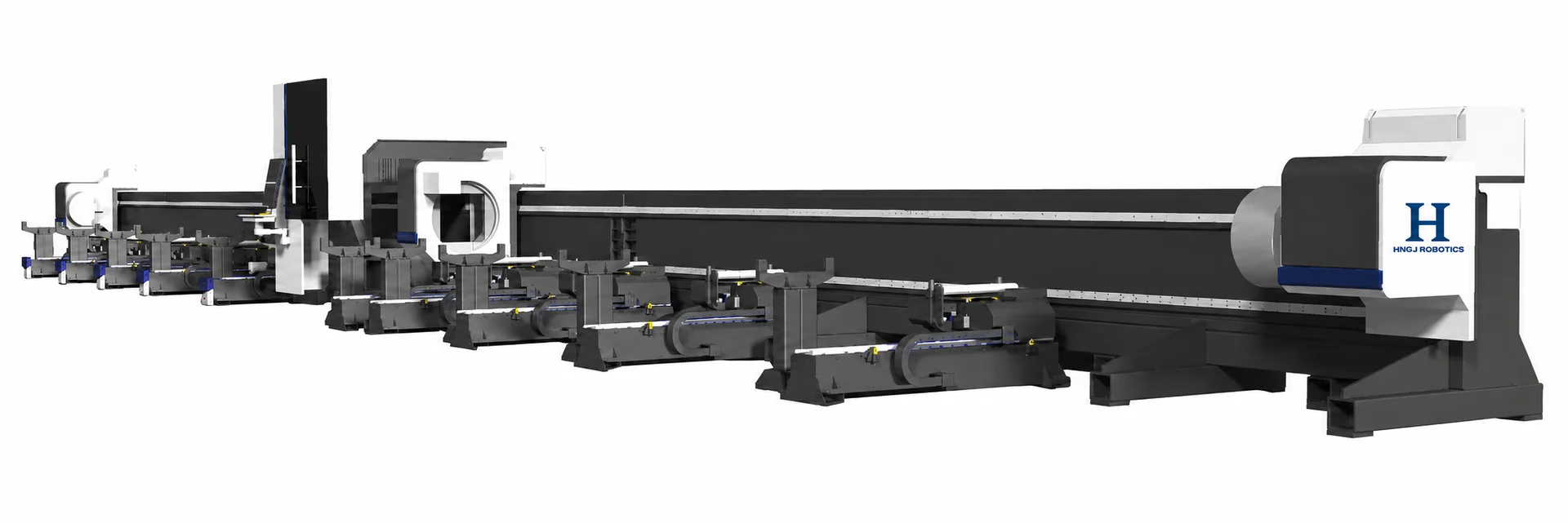
LY120-B SERIES
Heavy-duty multi-chuck laser
Three- and four-chuck configurations support heavier tube processing. Choose the handling architecture and rated capacity for the actual stock.
Tube cutting6–20 kW laser power
Enquire about this equipment01 / PRODUCT OVERVIEW
How this equipment works.
Three- and four-chuck tube-cutting configurations for heavier stock. Multiple clamping and support positions help organize long-workpiece handling, with model-specific chuck capacities and 6–20 kW laser power options.
Match the number of chucks to the stock and the required cutting sequence. Loading, clamping transitions and unloading need to be considered together, particularly for long pieces or parts with an uneven weight distribution.
Find the fit for your parts.
Long tube members requiring several support or clamping positions.
Large-section tube candidates, with geometry and clamping compatibility confirmed per model.
Before choosing a configuration
Confirm stock weight and centre of gravity, section geometry, support spacing and the finished-part handling sequence.
03 / PROCESS & CONFIGURATION
Designed for the task.
- Three- or four-chuck configurations.
- Heavy-stock capacity selected by model.
- Laser power range of 6–20 kW.
- Handling strategy is matched to tube size and weight.
TECHNICAL OVERVIEW
Key specifications
| Models | LY12024B / 12035B / 12042B / 12055B |
|---|---|
| Chuck capacity by model | 300 / 1100 / 1500 / 2500 kg |
| Power range | 6–20 kW |
Configuration reference: HNGJ Global. Parameters apply to the referenced configuration. Final scope is confirmed in the technical agreement. Robot-only figures are identified separately.
A useful brief gets a clearer proposal.
Send material grade and thickness, maximum part dimensions and weight, joint or cutting details, batch size, target output and the installation country. Describe the current process and the bottleneck you want to resolve.
04 / AFTER-SALES SUPPORT
Support throughout operation.
Build a service plan around your equipment, operators and installation location. The following items can be included in the agreed project scope.
Installation & commissioning
Review machine alignment, chuck or support setup, loading space and utilities. Confirm workpiece stability and carry out sample cutting with the agreed tube specification.
Operator training
Training can cover workpiece locating, clamping or support adjustment, job setup, cutting parameters and finished-part unloading.
Care & maintenance
Service planning focuses on multi-chuck synchronization, clamping calibration, support alignment and drive maintenance, with checks tailored to the installed handling system.
Troubleshooting & spare parts
Share the equipment model, fault code, operating conditions and relevant photos when requesting support. Diagnosis, replacement parts and any on-site visit are coordinated for the installed configuration and project location.
Warranty & service arrangements
Warranty duration, consumable coverage, software support and response arrangements are confirmed in the project agreement. Overseas on-site work, travel costs and parts delivery are agreed for the destination.
Related equipment
Your next step starts with a conversation.
Tell us what you make. Let’s define the right equipment configuration.